
For union officials, organisers and delegates
The Delegate Is Often the First Person an Injured Member Calls
We put the first steps of a NSW workers compensation claim in the room before anyone needs them.
WorkCover Hub runs member seminars, delegate training and on-site sessions for unions, and produces plain-English materials members keep. Sessions are led by people who work inside the scheme every day — our doctors across the network and the team who handle certificates, approvals and insurer correspondence.
Or call (02) 7238 7379
What we bring to a branch
- Member seminars at branch meetings
- Delegate training
- On-site sessions
- Plain-English materials
NSW workplaces. Shaped to your industry and your members, never run off a template.
Knowledge in the Room Before It's Needed
A claim can go wrong on procedure long before anyone looks at its merits. Every format below exists to get the first steps right.
Member seminars at branch meetings
A plain-English walk through what happens after a workplace injury in NSW — who to tell, what the certificate is for, how the first weeks run — fitted into the agenda of a branch or sub-branch meeting, with time for the questions members actually have.
Delegate training
For the person members come to first. The first conversation, the paperwork, the timeframes, and where the delegate's role ends and the union's own officials or legal pathways take over. Built around your training calendar, not ours.
On-site sessions
Short sessions at the workplaces where members work, arranged with the branch — a lunchroom, a depot, a crib room. Each industry carries different risks, so each session is shaped to the site rather than run off a template.
Plain-English materials
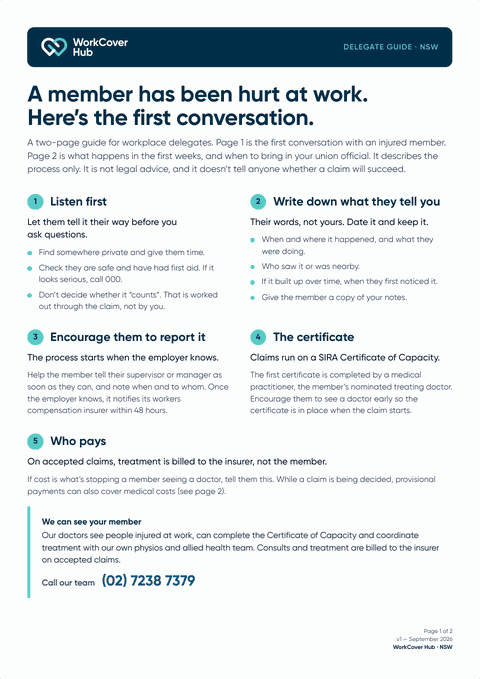
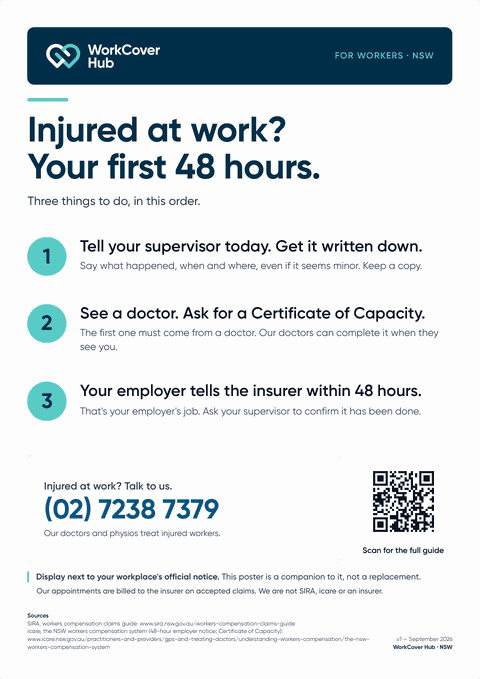
A delegate guide, a wallet card and lunchroom posters members can keep and come back to. Download and print them on an office printer, or order printed copies for the branch.
What a Delegate Can Do in the First Conversation
The process a delegate can walk a member through in NSW. It is the process, not legal advice — the delegate's job is making sure these steps happen, not assessing the claim.
- 1
The member reports the injury to their employer
Everything else in the scheme runs from this notification. The delegate's first job is making sure it has happened.
- 2
The employer notifies its insurer within 48 hours
In NSW that is usually icare's Nominal Insurer, with the claim managed by one of its agents; some employers are self-insured or covered by a specialised insurer.
- 3
The member gets a Certificate of Capacity
It is SIRA's form, completed by the member's nominated treating doctor. The first certificate must come from a medical practitioner.
- 4
Provisional payments can start
Provisional weekly payments begin within 7 days, for up to 12 weeks, unless the insurer has a reasonable excuse. The insurer then determines full liability within 21 days.
- 5
The claim has a 6-month time limit
Section 261 of the Workplace Injury Management and Workers Compensation Act 1998 sets a 6-month limit for making a claim, with relief available up to 3 years.
Sources (NSW, current September 2026)
- icare — The NSW workers compensation system
- Workplace Injury Management and Workers Compensation Act 1998 (NSW), s 261
The full sequence, with space for notes, is in the delegate guide.
Print It, Pin It, Hand It Out
Written for the member who has just been hurt: three steps, one phone number, nothing to decode. Download for an office printer, or order printed copies for the branch.


How Reporting Back Works
A branch should be able to see whether the work was worth the agenda time. A member's privacy is not negotiable. Both hold.
Aggregate counts only
If the branch wants to know what the work produced, we report numbers, not people: sessions run, attendance, materials sent out. De-identified, and never broken down so finely that a member could be recognised.
Member information stays with the member
Nothing about an individual member — whether they called, whether they were treated, how their claim is going — flows to the union, the employer or anyone else without that member's explicit consent.
No membership lists
We don't ask for them and we don't want them. Members who want to speak to us use the phone number on the materials, on their own terms.
The Lines We Don't Cross
Written down so a branch secretary can hold us to them.
No referral fees or inducements
No payments, gifts, commissions or benefits in either direction, for anything. Not to the union, not to delegates, not from anyone to us.
No testimonials
We don't collect or publish member stories, quotes or endorsements, and we don't use your union's name or logo.
No member data sharing
Member information is never shared or sold, and never used to market to members. Consent from the member is the only path for anything personal.
No crossing into legal advice
Sessions and materials explain the process. Where a member needs advice about their rights or a dispute, we say so plainly and the union's own pathways take over.
Tell Us About Your Members
The industry, the branch or site, roughly how many people, and whether it's a seminar, delegate training or an on-site session you have in mind. We'll come back to you to shape it and find a date that suits your calendar.
Choose Union as the organisation type so it reaches the right people.
Rather talk it through? Call (02) 7238 7379
Book a session
Questions Unions Ask Us
If yours isn't here, call or use the form — answering it is the point.
Bring the First Steps to Your Branch
Book a seminar or delegate training, order printed materials for the lunchroom, or call with the question a member is stuck on.
Call (02) 7238 7379